Appearance
Validation
All numbers on this page are measured by docs/validation/validate.py, which writes them to docs/validation/results.json and renders every table below from that file (see Regenerating). Errors are distances relative to the radius; times are those of the encoder alone, with default parameters unless stated.
Synthetic tubes with known geometry
furca synth generates tubes whose surface is known analytically (see furca_core::synthetic). Each preset is meshed at 400 rings × 64 segments with tangential jitter (the input) and at 3000 × 1536 without jitter (the reference surface). The encoding is triangulated at 1500 × 1024 and its distance to the reference measured, excluding half a radius at each end. The reference surface has a chordal error of about
| Preset | Shape | Radius | Feature vector | Mean | Max | Centerline to axis | Time |
|---|---|---|---|---|---|---|---|
straight | straight cylinder | 5 | 3197 | 0.33% | 0.5 s | ||
arc | 135° circular arc | 5 | 2288 | 0.24% | 0.4 s | ||
helix | 1.5-turn helix | 5 | 6174 | 0.66% | 0.8 s | ||
wave | planar wave, tapering | 5 | 5318 | 0.54% | 0.7 s | ||
stenosis | arc with a 50% eccentric stenosis | 5 | 2745 | 14% | 0.4 s | ||
elliptic | helix, elliptic section twisting ½ turn | 5 | 5068 | 0.56% | 0.7 s | ||
aortic-arch | 180° arch, tapering, slightly elliptic | 14 | 1581 | 0.49% | 0.3 s |
Centerline to axis is the largest distance from the encoded centerline to the exact axis of the tube. In stenosis the eccentric narrowing displaces the centres of its sections, which the centerline follows by design.
Every preset is reproduced close to the floor of the measurement, except elliptic, some ten times above it: the harmonic angle runs around an ellipse at constant speed, so its components carry more harmonics than its radius over the polar angle, and 24 coefficients reproduce them to
Adaptive knots
With a fixed budget of 14 centerline control points and
| Preset | Uniform knots | Adaptive knots (default) |
|---|---|---|
straight | ||
arc | ||
helix | ||
wave | ||
stenosis | ||
elliptic | ||
aortic-arch |
Adaptive knots pay off where the wall varies locally: they cut the error of stenosis four times. Where the wall varies little along the vessel they reproduce uniform knots, except in wave, whose error they increase by about half at this small budget. At the default resolution the difference is below the floor of the measurement.
Sections that are not star-shaped
Three synthetic tubes have sections that no radius function can describe (furca_core::synthetic::SectionShape): their polar angle about the centerline runs backwards along part of the section, so that rays from the centerline meet the wall more than once. Each is meshed at 400 rings × 128 segments with tangential jitter (their sections are longer for their area than a circle) and scored against its exact surface as above, in % of the radius of the undeformed tube, with 24 (the default) and 48 wall coefficients around the vessel.
| Preset | Sections | Not star-shaped | 24 coefficients around: mean / max | 48 coefficients around: mean / max | Time |
|---|---|---|---|---|---|
crescent | arc; a lesion bends the section into a crescent and back | 24% | 0.059% / 2.60% | 0.008% / 0.53% | 0.5 s |
kidney | helix; kidney-shaped sections all along | 100% | 0.11% / 0.95% | 0.009% / 0.10% | 0.8 s |
pinwheel | straight; three lobes curl over in the middle | 27% | 0.22% / 4.69% | 0.068% / 3.29% | 0.6 s |
Not star-shaped is the fraction of the encoded sections that are not (non_star_fraction). The harmonic angle runs forwards around every ring of all three, and the error decreases with the angular resolution as for any smooth section: these shapes are longer around, with tight turns at the tips of the crescent and of the lobes, and need more coefficients than a near-circular section. The 128 segments of the input cut the tips of the lobes of pinwheel by up to 1% of the radius, which is the floor of its measurement.
A radius function, the wall of the model before the harmonic angle, cannot represent the parts of the wall that turn back as seen from the centerline: on these presets it left errors of 25% (kidney), 40% (pinwheel) and 86% (crescent) of the radius.
Cerebral aneurysms
data/vmr/cerebral-aneurysm holds two saccular aneurysms of the cavernous internal carotid artery from the Vascular Model Repository [8], a matched pair of one that grew and one that stayed stable between checkups (Weiss et al., 2023, doi:10.3389/fphys.2023.1300754). Each is an unbranched segment of the artery with its sac. Around the neck the wall turns back as seen from the centerline, so part of their sections are not star-shaped. The table gives the distance from the open wall of the input to the triangulated model, in % of its mean radius, for a radius function (wall.angle = "polar") and for the general wall.
| Subject | Not star-shaped | Fold | Radius function, 24: mean / p99 / max | General wall, 24: mean / p99 / max | General wall, 48: mean / p99 / max | Default: model, mean / p99 / max |
|---|---|---|---|---|---|---|
0203_H_CERE_CA | 25% | 1.50 | 3.48% / 33.58% / 48.6% | 2.71% / 26.57% / 38.2% | 2.65% / 26.52% / 38.5% | lobe: 0.64% / 2.83% / 21.8% |
0204_H_CERE_CA | 7% | 1.37 | 1.67% / 21.46% / 48.0% | 0.65% / 6.39% / 26.7% | 0.43% / 4.38% / 21.3% | tube: 0.65% / 6.39% / 26.7% |
Loading the model…
Drag to rotate, scroll or pinch to zoom, right-drag to pan
The stable aneurysm, coloured by the distance from its wall to the model (0 to 10% of the radius). Switch the layers: the radius function cannot follow the wall where it folds back around the neck of the sac; the general wall does.
In the stable aneurysm the general wall reduces the error to between a half and a third everywhere: its mean from 1.7% to 0.65% of the radius, its 99th percentile from 21% to 6%. In the growing one the improvement is smaller: its sac lies inside a tight loop of the carotid siphon, where the plane of a section meets the wall in more than one curve. One closed curve per section cannot describe that, whatever its shape, and the error there stays at about two fifths of the radius with the general wall and half of it with the radius function. The default encoding models that sac as a saccular lobe, and its largest error falls to 4.4% of the radius; in the stable aneurysm the tube fits better than a lobe and is kept (the last column).
Aneurysms in branched vessels
Saccular aneurysms at junctions, such as terminal aneurysms of the internal carotid artery, are dead ends that belong to no branch; they are modelled as saccular lobes, and validated there on a synthetic terminal aneurysm and on four cerebral aneurysms in data/vmr/cerebral-aneurysm-branched.
Tight bends
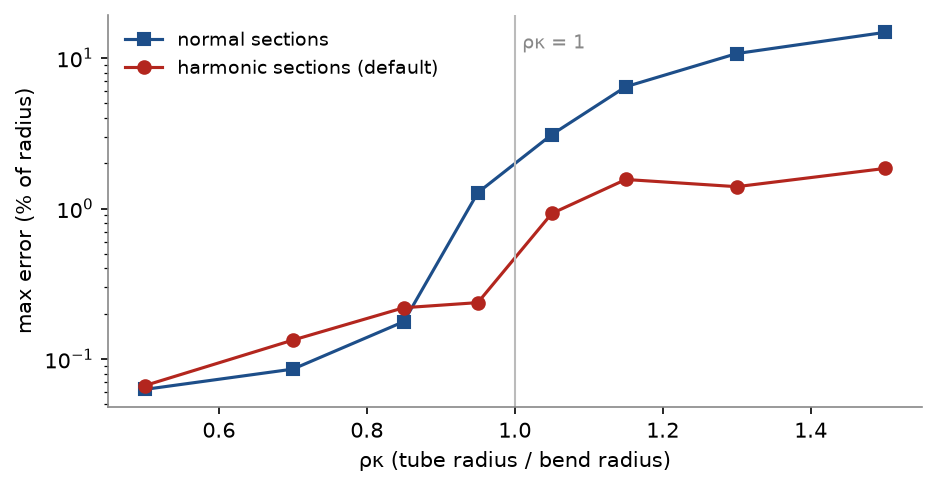
Tubes with a 120° bend whose radius
| 0.50 | 0.70 | 0.85 | 0.95 | 1.05 | 1.15 | 1.30 | 1.50 | |
|---|---|---|---|---|---|---|---|---|
| normal sections | 0.063% | 0.086% | 0.18% | 1.3% | 3.1% | 6.4% | 11% | 15% |
| harmonic sections (default) | 0.067% | 0.13% | 0.22% | 0.24% | 0.93% | 1.6% | 1.4% | 1.8% |
| largest fold, harmonic | 0.43 | 0.57 | 0.65 | 0.74 | 0.84 | 0.90 | 0.90 | 0.95 |
Normal sections fold once the centerline's centre of curvature lies inside the vessel, from
Convergence. Largest error (99th percentile in brackets) as the longitudinal wall resolution wall.tau_size grows, in coefficients per radius:
| 0.50 | 0.70 | 0.85 | 0.95 | 1.05 | 1.15 | 1.30 | 1.50 | |
|---|---|---|---|---|---|---|---|---|
| normal, 3 per radius (default) | 0.063% (0.036%) | 0.086% (0.051%) | 0.18% (0.092%) | 1.3% (0.51%) | 3.1% (1.1%) | 6.4% (4.5%) | 11% (8.2%) | 15% (12%) |
| normal, 4.5 per radius | 0.025% (0.013%) | 0.039% (0.022%) | 0.054% (0.030%) | 0.35% (0.10%) | 3.0% (1.1%) | 6.5% (4.5%) | 11% (8.1%) | 15% (12%) |
| normal, 6 per radius | 0.012% (0.0059%) | 0.021% (0.012%) | 0.029% (0.015%) | 0.20% (0.052%) | 3.0% (1.1%) | 6.5% (4.6%) | 11% (8.1%) | 15% (12%) |
| harmonic, 3 per radius (default) | 0.067% (0.041%) | 0.13% (0.071%) | 0.22% (0.11%) | 0.24% (0.13%) | 0.93% (0.16%) | 1.6% (0.26%) | 1.4% (0.24%) | 1.8% (0.51%) |
| harmonic, 4.5 per radius | 0.027% (0.014%) | 0.045% (0.026%) | 0.10% (0.042%) | 0.16% (0.061%) | 0.97% (0.12%) | 0.98% (0.13%) | 1.2% (0.18%) | 1.1% (0.21%) |
| harmonic, 6 per radius | 0.013% (0.0068%) | 0.032% (0.012%) | 0.052% (0.023%) | 0.13% (0.046%) | 0.59% (0.10%) | 1.0% (0.13%) | 0.92% (0.13%) | 0.82% (0.15%) |
Where normal sections are valid, both kinds of sections converge alike. Once they fold, refining makes normal sections worse, up to more than 100%: the wall function has to follow the coordinates into the fold. Harmonic sections converge for
Real vessel segments
The six segments of the descending aorta in data/vmr/aorta-descending (from the Vascular Model Repository [8]; see data/README.md for their provenance). There is no ground truth, so the table reports the distance from every input vertex to the encoded surface, relative to the mean radius:
| Segment | Vertices | Feature vector | Mean | 95th pct. | Max | Max, normal sections | Max fold | Time |
|---|---|---|---|---|---|---|---|---|
0008_H_AO_H | 22784 | 3654 | 0.005% | 0.014% | 0.12% | 0.55% | 0.38 | 0.5 s |
0011_H_AO_H | 22822 | 4207 | 0.005% | 0.017% | 0.11% | 0.60% | 0.32 | 0.6 s |
0012_H_AO_H | 23327 | 2591 | 0.017% | 0.043% | 0.16% | 0.84% | 0.30 | 0.4 s |
0015_H_AO_COA | 16105 | 4308 | 0.006% | 0.027% | 0.078% | 0.44% | 0.32 | 0.5 s |
0017_H_AO_COA | 29481 | 4861 | 0.012% | 0.031% | 0.14% | 0.88% | 0.27 | 0.7 s |
0071_H_AO_H | 12036 | 2442 | 0.048% | 0.124% | 0.36% | 1.61% | 0.40 | 0.3 s |
Loading the model…
Drag to rotate, scroll or pinch to zoom, right-drag to pan
Distance from each input vertex of segment 0011 to its encoding, relative to the mean radius (viridis: dark is small).
In these segments the largest fold stays well below one, so normal and harmonic sections give the same accuracy; harmonic sections matter in bends tighter than the vessel, as in the benchmark above.
Angular resolution
Real cross-sections have angular detail (the surfaces were lofted from segmentation contours), so wall.theta_size dominates the error. Mean / maximum distance (%) on the same segments:
| Segment | 16 | 24 (default) | 32 | 48 |
|---|---|---|---|---|
0008_H_AO_H | 0.015 / 0.16 | 0.005 / 0.12 | 0.002 / 0.10 | 0.002 / 0.09 |
0011_H_AO_H | 0.014 / 0.16 | 0.005 / 0.11 | 0.003 / 0.08 | 0.002 / 0.08 |
0012_H_AO_H | 0.052 / 0.39 | 0.017 / 0.16 | 0.007 / 0.07 | 0.003 / 0.07 |
0015_H_AO_COA | 0.018 / 0.20 | 0.006 / 0.08 | 0.003 / 0.08 | 0.002 / 0.08 |
0017_H_AO_COA | 0.036 / 0.26 | 0.012 / 0.14 | 0.005 / 0.15 | 0.002 / 0.14 |
0071_H_AO_H | 0.291 / 1.55 | 0.048 / 0.36 | 0.020 / 0.32 | 0.017 / 0.30 |
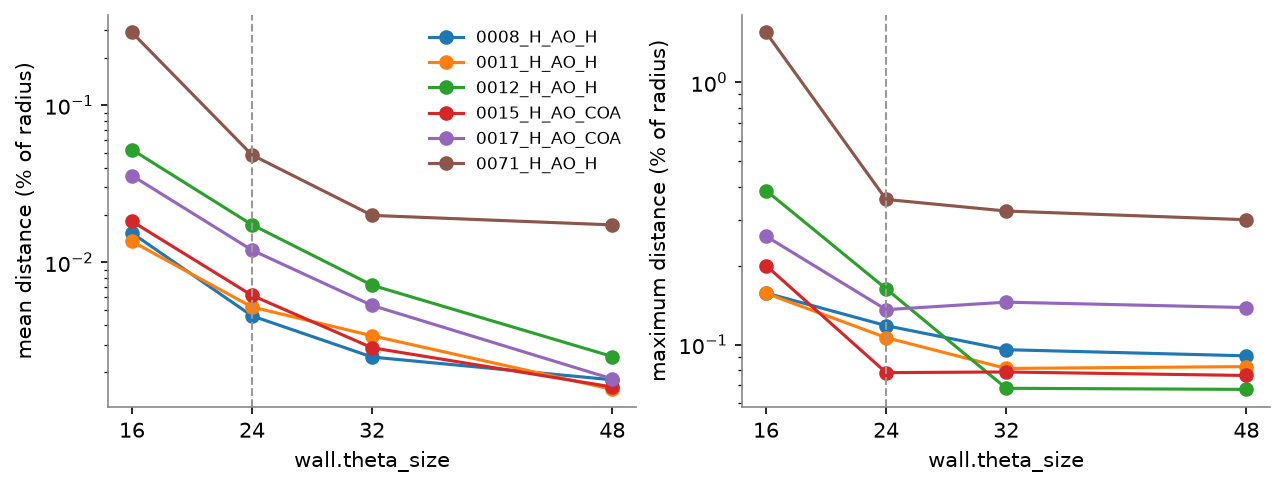
Beyond 32 coefficients the error no longer decreases: the remaining residual is the faceting of the input triangulation, and higher resolutions start to fit it.
Branched vessels
The branched synthetic presets are smooth unions of straight cylinders (an independent construction, see furca_core::synthetic::SyntheticTree), triangulated with faces of 0.5 (radius 5). In crescent-branch the narrower child of a bifurcation swells along its middle into a crescent that is not star-shaped about any point of its centerline, its core a circular arc of 229° (SweptArc). The error is the distance from the triangulated model (faces an eighth of the radius across) to a fine triangulation of the exact surface, away from the cut ends, relative to the trunk radius. Harmonic is the number of branches parametrized by their harmonic angle, and Max, polar angle the largest error with every branch parametrized by its polar angle (wall.angle = "polar"):
| Preset | Tree | Harmonic | Feature vector | Mean | Max | Max, polar angle | Sweeps | Time |
|---|---|---|---|---|---|---|---|---|
bifurcation | 3 branches, 1 bifurcation | 0 | 4526 | 6 | 3.1 s | |||
side-branch | 2 branches, 1 side | 0 | 4066 | 14 | 1.7 s | |||
crescent-branch | 3 branches, 1 bifurcation | 1 | 5993 | 10 | 8.9 s |
The circular presets keep the polar angle in every branch. The crescent child is parametrized by its harmonic angle, and the largest error drops elevenfold, from 44% of the trunk radius (a wall over the polar angle cannot follow the crescent) to 4%.
Loading the model…
Drag to rotate, scroll or pinch to zoom, right-drag to pan
The crescent bifurcation, its exact wall coloured by the distance to the model (0 to 10% of the trunk radius). Switch the layers: with the polar angle in every branch, the wall of the crescent child cannot follow it; with its harmonic angle, it does, and the parent and the other child, which keep their polar angle, are unchanged.
The six aortic arches in data/vmr/aortic-arch keep the roots of their three supra-aortic branches (see data/README.md). The table reports the distance from every input vertex to the model, relative to the radius of the aorta:
| Arch | Tree | Harmonic | Vertices | Mean | 95th pct. | Max | Max, polar angle | Time |
|---|---|---|---|---|---|---|---|---|
0007_H_AO_H | 4 branches, 3 side | 2 | 26413 | 0.035% | 0.141% | 0.62% | 1.75% | 3.3 s |
0009_H_AO_H | 4 branches, 3 side | 0 | 23843 | 0.106% | 0.498% | 4.66% | 4.66% | 1.7 s |
0015_H_AO_COA | 4 branches, 3 side | 0 | 38269 | 0.142% | 0.631% | 3.06% | 3.06% | 1.4 s |
0016_H_AO_COA | 4 branches, 3 side | 0 | 30610 | 0.138% | 0.627% | 3.55% | 3.55% | 2.5 s |
0067_H_AO_H | 4 branches, 3 side | 0 | 13892 | 0.198% | 1.140% | 5.51% | 5.51% | 1.1 s |
0070_H_AO_H | 4 branches, 3 side | 0 | 15592 | 0.185% | 0.958% | 4.77% | 4.77% | 0.9 s |
In arch 0007 the aorta and one of its supra-aortic branches fit their data with less than half the residual when parametrized by their harmonic angles, and the largest error of the vessel drops from 1.75% to 0.62% of the aortic radius; the other arches keep the polar angle in every branch, with the same result as with wall.angle = "polar".
Loading the model…
Drag to rotate, scroll or pinch to zoom, right-drag to pan
Distance from each input vertex of arch 0070 to its model, in percent of the aortic radius (viridis: dark is small). The largest distances are at the rims of the mouths, where the smooth union rounds the edge.
Away from the junctions, every branch is fitted as a tube and as accurately. The largest distances are at the rims of the mouths, a few percent of the radius. Arch 0016 (coarctation) has an arch hardly wider than its brachiocephalic trunk; it is fitted both as a bifurcation and as a trunk, and the trunk is chosen (Trunks and bifurcations): as a bifurcation, the extension of the arch behind its data leaves a bump of most of the radius in the crotch.
A cohort of branched vessels
The six arches make a cohort with the same tree, four branches and three side branches. Its shape model has 3316 features (the radial and tangential components of every wall) and five modes, explaining 46.0%, 23.3%, 15.7%, 9.9% and 5.2% of the variance; encoding, aligning and modelling the cohort takes about 12 s. Every branch is parametrized by its polar angle in all six subjects (only one of them chose the harmonic angle for any branch, see junctions.harmonic_subjects). The triangulation of the mean shape (faces a quarter of the radius of its narrowest branch across, 20570 vertices) is carried onto every subject. The table gives the distance from its vertices to the subject's own triangulated wall, relative to the radius of the subject's aorta, and the edges where the carried mesh folds (its two faces meet at more than a right angle; the mesh of the mean has none):
| Subject | Mean | 99th pct. | Max | Folded edges |
|---|---|---|---|---|
0007_H_AO_H | 0.036% | 0.187% | 25.12% | 118 (0.20%) |
0009_H_AO_H | 0.124% | 0.511% | 52.03% | 542 (0.90%) |
0015_H_AO_COA | 0.046% | 0.401% | 22.43% | 316 (0.52%) |
0016_H_AO_COA | 0.042% | 0.310% | 20.43% | 139 (0.23%) |
0067_H_AO_H | 0.025% | 0.245% | 7.39% | 36 (0.06%) |
0070_H_AO_H | 0.036% | 0.221% | 16.11% | 28 (0.05%) |
The carried meshes lie on the subjects' walls except in small patches, in the crotches between close branches, where the junctions of the subject and of the mean differ most, a few vertices are left up to half a radius away and up to 1% of the edges fold.
Regenerating
sh
python docs/validation/validate.py                 # every section (a few minutes)
python docs/validation/validate.py --only real     # some sections
python docs/validation/validate.py --render        # tables only, from results.json
python docs/figures/make_figures.py --only bends angular
Measured with furca 0.1.0 (commit c9e1d87) on Apple M1, 8 threads, on 2026-11-20.
Tests
cargo test checks, among others:
- B-spline partition of unity, derivative consistency and periodic continuity;
- that GCV denoises a noisy signal to well below the noise level, and that the block-banded solver of the wall gives the same fit as the dense one;
- the rotation-minimizing frame against the analytic holonomy of a helix;
- end-to-end accuracy on the
arcandellipticpresets; - that encodings are equivariant under rigid motions of the input.