
Appearance
O-grid volume meshes
Every cross-section of the lumen is bounded by its wall curve theta_res.
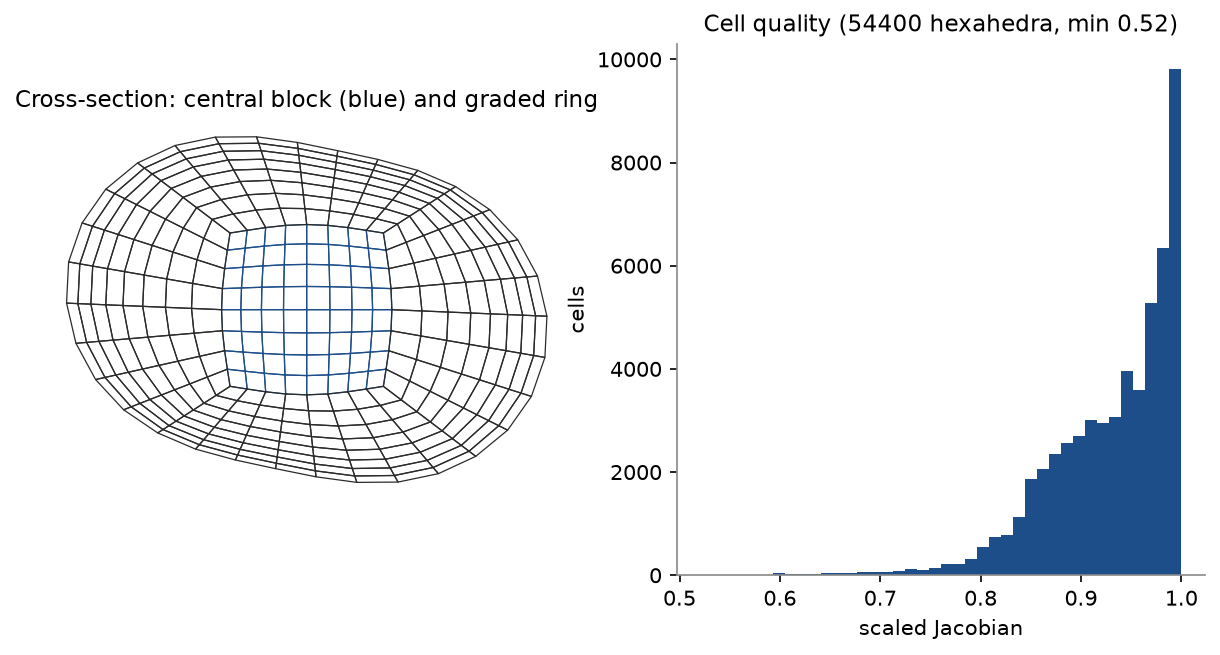
A cross-section of the o-grid of the twisting elliptic preset (left) and the scaled Jacobian of all its hexahedra (right; 1 is a perfect cube).
Construction of a section
In the local frame
- Wall nodes.
with . - Block boundary. A square with corners at
and half-diagonal ( = core_fraction), sampled withequal segments per side so that node faces wall node . It is blended towards a circle by core_roundness: , with the mean of the inscribed and circumscribed radii. - Ring. Layer
( = radial_layers) is, where the thicknesses form a geometric sequence with ratio wall_growthfrom the wall inwards, so that the layers next to the wall are the thinnest (boundary layer). - Block interior. Transfinite (Coons) interpolation of the four sides of the block (Gordon & Hall [14]):
Sections are placed at tau_res uniform values over the wall domain (by default, so that cells are about as long as they are wide at the wall) and consecutive sections are joined into hexahedra.
Sections that are not star-shaped
The lines from the central block to the wall need the section to be star-shaped about the block. Where the algebraic grid of some section folds (nodes = "auto", the default, or always with nodes = "smoothed"), the nodes of every section are instead placed by minimizing a shape energy, with the wall nodes
The energy. Every corner of every quadrilateral, with edge vectors
A corner contributes one when it is its target turned and scaled, more for any other shape, and an infinite amount as it degenerates (
Along the vessel. The energy has to start from a valid grid. The first section whose algebraic grid is valid is smoothed from it; if none is (a vessel deformed all along), the first section is reached from the algebraic grid of a circle of its area about the centroid of its wall nodes. From there the grid is carried from section to section in both directions: its wall nodes move towards those of the next section by the longest steps that leave every cell valid (halved as needed), with a few sweeps of smoothing after each, and the grid is smoothed to convergence once they arrive. This homotopy keeps every grid valid, and since each is the minimizer of the energy of its own section, consecutive sections differ as little as their walls do.
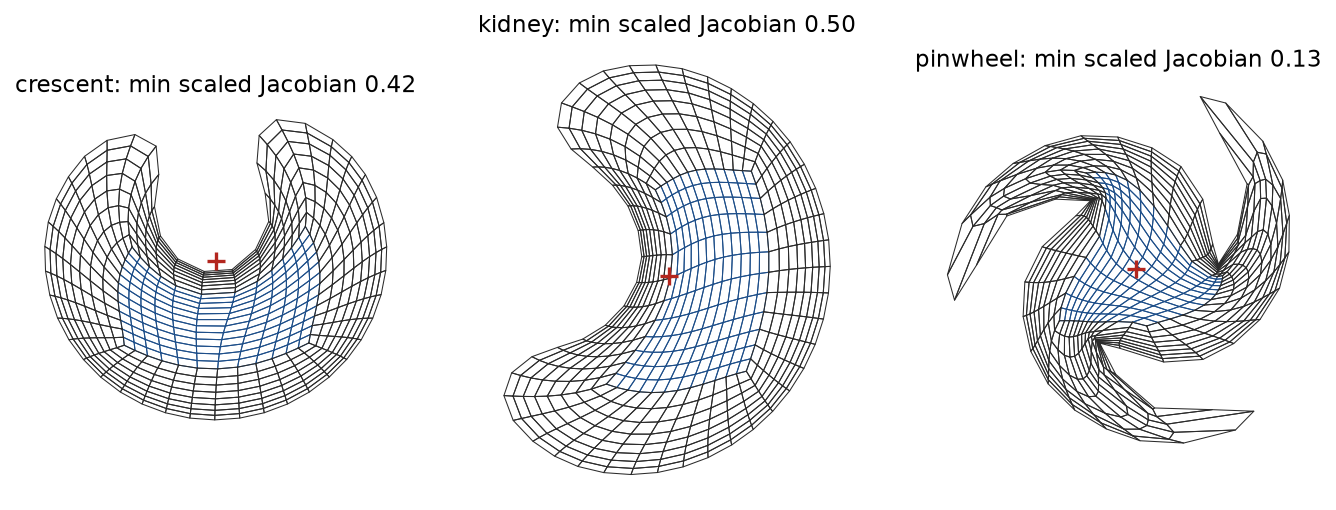
Middle sections of the smoothed o-grids of the synthetic tubes that are not star-shaped (theta_res = 48, 8 layers): central block in blue, the centerline point as a cross. The wall nodes are equally spaced in the harmonic angle, which gives the narrow arms of the pinwheel few of them; a larger theta_res resolves them.
Loading the model…
Drag to rotate, scroll or pinch to zoom, right-drag to pan
The o-grid of a twisting elliptic vessel: the wall and a few cross-sections of the volume, with their cells coloured by their relative radius (0 at the centre, 1 on the wall) and their edges. Zoom in on a section to see the central block and the graded ring around it.
Properties
- Correspondence. The topology depends only on
theta_res,radial_layersandtau_res, and nodes are placed in vessel coordinates. For subjects with a shared structure (Cohorts), nodehas the same and relative radius in every subject. - Quality. All cells of the test cases have positive scaled Jacobians (minimum about 0.8 for the defaults on both the synthetic presets and the real segments). The lowest values occur at the four corners of the central block, where three cells of the block meet two of the ring.
furca volumereports the minimum. - Smoothed sections are slower to build (a few seconds for a vessel at the defaults, against a fraction of a second) and, with
nodes = "auto", a single section that is not star-shaped makes every section of the vessel smoothed. Their quality is lower where the section has narrow protrusions (minimum scaled Jacobian 0.42 on the crescent, 0.50 on the kidney and 0.13 on the pinwheel, at 48 nodes around). - Branched vessels have no volume meshes yet.