Appearance
Centerline
Definition
The harmonic field on the wall has level sets that are rings around the vessel and never cross, however tightly the vessel bends. Their length-weighted centroids
where centerline.penalty_order, default 3). With the parameter proportional to arc length,
The cut-off length centerline.stiffness
Loading the model…
Drag to rotate, scroll or pinch to zoom, right-drag to pan
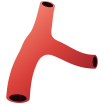
The centerline of a real descending aorta: the centroids of the level sets of the harmonic field (the initial points), the fitted curve and its control points. The layers can be shown and hidden.
Why the third derivative
The classical smoothing spline penalizes the bending energy,
- At the ends. The minimizer satisfies the natural boundary condition
: the curve leaves a bend straight. Near the end of a curved segment it departs from the axis, and the sections built on it look tilted with respect to it. - Inside a bend. A circular arc of curvature
costs per unit length, so the fit trades some distance to the data for less curvature and cuts the bend short, by an amount of order .
With
On synthetic tubes, whose axis is known exactly, the bending penalty left the centerline up to a fifth of a radius away from the axis near the ends of an arch, with spurious section tilts of up to 16°. The third-order penalty keeps it within a few thousandths of a radius (Validation), and centres the sections of the real segments two to three times better.
The number of control points (centerline.size) is chosen generously: the cut-off, not the resolution, decides the smoothness.
Why not generalized cross-validation
The first versions of furca chose the smoothing of the centerline by generalized cross-validation, as for the wall. GCV assumes independent errors, but consecutive level-set centroids are strongly correlated (neighbouring rings share most of their geometry). GCV then under-smooths: with few control points this goes unnoticed, but with the resolution needed in tight bends the centerline wiggles, and the error is amplified on the inner side of bends (see below). A physical cut-off has no such failure mode.
Why not iterative centering
The first versions also centered the centerline iteratively, moving it until the cross-sections normal to it had no first angular Fourier mode. In tight bends this is ill-posed: the normal sections themselves depend on the curve being moved, sections near the inner side compress (the area element of normal-section coordinates carries a factor
Tight bends
The centerline does not have to be less curved than the axis for the coordinates to survive tight bends: the tilted harmonic sections never cross, whatever the curvature of the centerline. It can therefore follow the axis closely. On a benchmark of tubes with a 120° bend, the earlier GCV-smoothed and iteratively centred centerline failed from
Centring diagnostic
After the fit, furca measures how well the centerline is centred in its cross-sections: in bins along the vessel (centerline.offset_bins) whose angular sectors (centerline.offset_sectors) all contain data, it fits centerline_offset). In straight and gently curved vessels it is a few percent of the radius; in tight bends it grows, because the centroid of a harmonic ring and the Fourier centre of a normal section are different notions of centre once sections are no longer parallel.
Ends
Vessel segments are usually cut by planes that are not exactly normal to the centerline. With an oblique cut, part of the wall lies beyond the normal plane at the end of the centerline. Rather than moving the centerline to cover it, which couples the shape of the curve to the cut, furca extends the coordinate system: beyond its ends the centerline continues along its end tangents with a constant frame (see Vessel coordinates). Every point near the vessel then has coordinates, with
The wall is fitted over a longitudinal domain ends.mode:
boundary(default): the smallest interval containing theof every vertex. The end sections are then the normal planes that just contain the whole surface and every vertex is fitted. Near an oblique end the sections are only partly covered by data; the penalty extrapolates the wall smoothly over the uncovered part. centroid:, so the model ends at the boundary centroids. Vertices with outside by more than ends.axial_tolerance(in arc length) are not fitted.
On the real test segments, boundary mode reduces the largest distance from the input to the model from 6–23% of the radius to below 2%. The extensions it needs are small, typically 0.05–0.4 radii.