Appearance
Command line reference
Run furca <command> --help for the authoritative list of options.
| Command | Purpose |
|---|---|
encode | Encode a vessel surface mesh, branched or not, into a .furca document. |
reconstruct | Triangulate the surface of an encoding. |
centerline | Export the centerline of every branch of an encoding as polylines. |
volume | Build an o-grid hexahedral volume mesh (details). |
coords | Map points to vessel coordinates and back (details). |
evaluate | Distance between an encoding and a mesh. |
compare | Distance between two meshes. |
cohort | Encode, align and model a cohort, branched or not (details). |
model | Sample shapes from a shape model; model modes writes meshes with the same faces (details). |
inspect | Summarize a mesh, an encoding or a shape model. |
synth | Generate a synthetic vessel (unbranched or branched) with known geometry. |
Mesh formats are chosen by extension: .vtp, .vtk (legacy), .stl, .obj (read and write) and .ply (write only).
furca encode
text
furca encode <MESH> [-o OUT.furca] [--params FILE.toml]
             [--inlet largest|smallest | --inlet-near X,Y,Z]
             [--centerline-size N] [--tau-size N] [--theta-size N]
             [--smoothing auto|VALUE] [--reference X,Y,Z]
             [--knots adaptive|uniform] [--ends boundary|centroid]
             [--reconstruct MESH [--theta-res N] [--tau-res N]] [--json]
Parameters can be given in a TOML file (see Encoder parameters); flags override the file. A surface with more than two open boundaries is encoded as a branched vessel: the report then shows its tree, every branch and the residual at the junctions.
furca reconstruct
text
furca reconstruct <ENCODING> -o <MESH> [--tau-res N] [--theta-res N] [--spacing LENGTH]--theta-res is the number of vertices per ring (default 96) and --tau-res the number of rings. By default the rings are spaced so that the quads are approximately square:
A branched vessel is triangulated as the zero set of its smooth union (Triangulating the wall), with faces --spacing across (default: the spacing of --theta-res vertices around its narrowest branch).
furca centerline and furca coords
centerline writes one polyline per branch with the arrays tau, mean_radius (the equivalent radius of the section) and branch. For an unbranched vessel, coords adds the wall coordinates phi and d to tau, theta and rho. For a branched vessel, coords gives every point the coordinates of the branch that dominates there: CSV output has the columns branch,tau,theta,rho, mesh output a branch array beside tau, theta and rho, and --inverse reads branch,tau,theta,rho.
furca evaluate and furca compare
Both report, in each direction, the mean, RMS, 95th percentile and maximum of the point-to-surface distance, and the symmetric Hausdorff distance. evaluate compares against a triangulation of the encoding with --theta-res vertices per ring (default 512, chordal error about --write-distances MESH to save the per-vertex distances of the first surface for visualization.
Distances from the vertices of one surface to the other are exact point-to-triangle distances, searched among the triangles incident to the 16 nearest vertices.
furca synth
Presets: straight, arc, helix, wave, stenosis, elliptic, aortic-arch. --resolution RINGS,SEGMENTS sets the grid and --jitter moves interior vertices tangentially so that the mesh is not perfectly structured. All vertices lie on the exact surface.
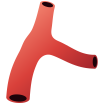
Branched presets: bifurcation (a parent dividing into two children 30° either side), side-branch (a trunk with a side branch at 60°), crescent-branch (a bifurcation whose narrower child swells into a crescent along its middle), terminal-aneurysm (a T-shaped bifurcation with a spherical sac on its apex) and side-aneurysm (a straight tube with a spherical sac on its side), smooth unions of cylinders (and of the swept arc of the crescent, and of the sphere of the sac) with radius 5 at the trunk. --spacing sets the size of their faces (default 0.5).